

Recently, the research group of Pan Yufeng from Southeast University, in collaboration with the team of Tong Xiajing from the School of Life Science and Technology at ShanghaiTech University and the team of Li Qian from Shanghai Jiao Tong University School of Medicine, published a review titled "Sexual dimorphism in pheromone perception across worms, flies, and rodents" online in the internationally renowned journal Trends in Neurosciences. This work systematically reviews the neural mechanisms underlying pheromone perception and its sexual dimorphism in nematodes (Caenorhabditis elegans), fruit flies (Drosophila melanogaster), and mammals represented by rodents. It reveals common principles and evolutionary strategies in chemical perception and sex-specific regulation across species, offering new perspectives for understanding the neural basis of sex-specific behaviors.
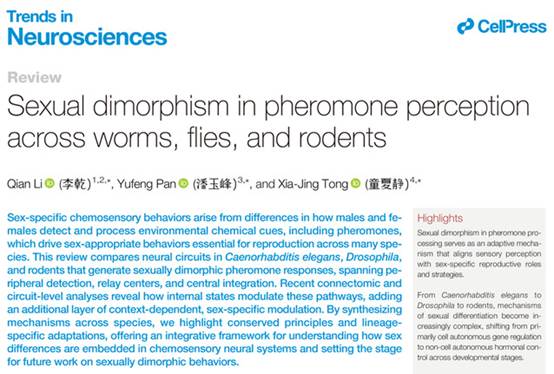
For many animals, pheromones are a silent language. These chemical signal molecules released by an individual animal can regulate the physiological states and behavioral responses of other individuals within the same species, used for recognizing conspecifics, attracting mates, or defining territory. Surprisingly, males and females often exhibit different responses to the same chemical signals: male pheromones can attract females but alert other males or trigger aggression; signals released by females can stimulate courtship behavior in males. Research has found that this difference stems from distinct "circuit designs" in the nervous systems of the two sexes—the neural pathways and activated brain regions for processing pheromones differ between males and females. Furthermore, an individual's internal state (such as hunger, estrus, or pregnancy) can dynamically modulate these responses, causing the same odor to carry different "meanings" in different contexts. In other words, sex and state jointly shape the brain's interpretation of the olfactory world.
Cross-species comparisons reveal that different animals form sexual dimorphism in the brain in varied ways. In nematodes, differences primarily occur at the sensory input level—a change in a single neuron can switch behavior from "attraction" to "aversion." In fruit flies and mammals, however, the sensory input pathways are largely similar, with key differences concentrated in central nodes for information integration, such as the pC1 neurons in fruit flies, and the medial amygdala (MeA), bed nucleus of the stria terminalis (BNST), and ventromedial hypothalamus (VMH) in mice. These neural hubs differ between sexes in terms of neuron number, connectivity, activation thresholds, and hormonal sensitivity, thereby determining sex-specific behavioral responses.
Based on the above cross-species comparisons, the authors propose two common principles of neural organization across species:
(1) Scaling Principle: As nervous system complexity increases, sexual dimorphism shifts from the peripheral sensory layer to central integration layers.
(2) Gating Motif: Factors such as internal hormones, metabolism, or social experience can "gate" key neural nodes (e.g., RMG in nematodes, pC1 in fruit flies, MeA/BNST/VMH in mice), enabling context-dependent sexual differences within shared sensory pathways.
In humans, although the role of pheromones remains debated, growing evidence suggests that humans might also retain similar chemical signaling pathways for regulating social, emotional, and sex-related behaviors. Research in this direction may provide new insights into understanding the evolution of the "sexed brain" in humans and related disease disparities. Additionally, the authors propose that sexual dimorphism does not originate from the specialization of a particular sensory system but is an evolutionarily conserved neural design strategy, allowing animals to balance ecological demands with reproductive needs. The principles discussed in this review might also apply to other sensory systems like vision and hearing.
Investigator Tong Xiajing from ShanghaiTech University, Professor Pan Yufeng from Southeast University, and Investigator Li Qian from Shanghai Jiao Tong University School of Medicine are the co-corresponding authors of this review. (School of Life Sciences)
Link to original article: https://doi.org/10.1016/j.tins.2025.10.007